Tyga Cat Food Review
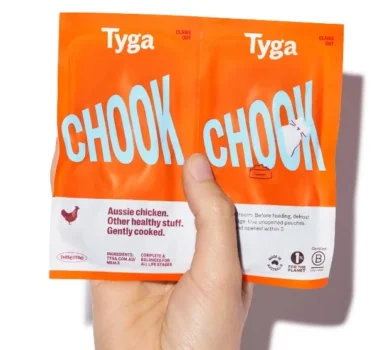
Tyga is a fresh, gently cooked cat food made in Australia using Australian meat and organs. If you want a comparison, it’s a bit like Lyka or 5 Hounds, but for your cat.
I scouted around social media to get a good idea of what people were saying, and found some negativity around the lack of meat content…. which is crazy considering all recipes are around 90% animal protein, which is a lot (and a crazy amount more than you’ll get in any processed grain-based kibble!)
Some say their cat didn’t take to Tyga, but with cats being somewhat autistic I’ve found it very common for cats to get confused by new food. Especially if they’ve been used to hard nuggets of grain since kittenhood. It’s the same for my 5 year old human child – if I put something unusual on her dinner plate, her initial reaction is usually “WTF is that?”
The truth is slow cooked foods such as Tyga are much healthier and more natural for your fluffy pet predator carnivore, and I wish more cat foods were like this. Yes, it’s not pure RAW or BARF, but you may not be keen on the hassle of raw (or not yet, anyway).
My initial view is Tyga would be a huge nutritional improvement over any dry cat food, and perhaps not quite up there with the likes of CatChi and Frontier Pets, but you may find price a factor as well.
Let’s take a closer look…
What the marketing says
Tyga’s message is pretty straightforward – cats are carnivores, so feed them “real food”.
How can I argue with that?
Like Lyka and similar truly premium modern pet foods, Tyga is made from human-grade Australian meat, organs and “superfoods”. No grains or fillers either, which is great, because your cat shouldn’t be eating that stuff anyway.
Tyga is gently cooked at 85°C rather than being cooked at the much higher temperatures used for nuking any-old-crap in a great big kibble making machine.
You’ll also find the claim Tyga has been formulated by Board Certified Veterinary Nutritionists, and by the looks of the recipes they’ve done a pretty good job.
With Tyga you’ll find four recipes (at the time of writing), and these are:
- “Chook” – chicken & chicken organs
- “Roo” – kangaroo & chicken organs
- “Big Chook” – turkey & pork organs
- “Pig” – pork & pork organs
I’ll give the marketing of Tyga a pass (it all looks fine to me, and I see no reason to pick holes), so let’s start digging in to the ingredients and how appropriate they are for your cat.
What the ingredients really say
Right, you may have noticed with the recipe names above that there’s a bit of a mismatch in the ingredients. For example, we know what a “Roo” is, but this is made with chicken organs. And for the “Big Chook” recipe we find turkey and pork organs.
Isn’t that odd?
I wouldn’t call a pig a chook. Would you?
The truth is it doesn’t really matter, unless you have a cat who for whatever reason has an intolerance of a specific type of meat protein. Most cats couldn’t give a damn where their meat and organs come from, as long as you feed them meat and organs instead of cremated grains, potato, tapioca, or some concoction of vegetables.
Personally, I’d recommend mixing and matching and offering your cat a variety.
It’s great to see around 90% animal ingredients in each recipe, and even the non-animal ingredients can be seen as rounding off the food to make it very nutritious for your cat. CatChi as a comparison is around 97% to 98% meat and organs, so you can see why I rate that so highly, but traditional dry cat food is usually under half animal ingredients, if not less, which makes Tyga leaps and bounds better.
It seems all recipes have “purified beef bone powder” – this is great as your carnivorous cat needs bone in their diet. The issue I find with this (which can be said for all commercial cat foods, is bone powder does nothing for keeping your cat’s teeth free from plaque and tartar – they need to chew and gnaw for that wonderous health benefit).
You’ll find tuna, salmon oil, green lipped mussels and so forth in the formulas – I have zero complaints with the addition of fish, fish oils, and the excellent green lipped mussels to support your cat’s heart health, skin, coat, and joints. These are signs of a solid feline diet.
When it comes to the non-animal ingredients it’s clear they’ve been considered for their specific nutritional merit, included in moderation to provide benefit (rather than in excess to reduce cost). These ingredients include organic psyllium husk (for added fibre), nutritional yeast and yeast extract (for for B vitamins and amino acids), and North Atlantic kelp (for for B vitamins and amino acids). All good.
All in all I find Tyga very good and deserving of a high rating based on the ingredients and nutritional analysis.
Yes, Tyga’s more expensive than conventional cat foods, but you’ll also be feeding a food formulated for the real nutritional needs of your cat rather than having the wool pulled over your eyes by some big corporate marketing department.
Recommended.
Ingredients
Ingredients of Tyga “Chook” cat food:
Chicken, chicken liver, chicken heart, chicken giblets, nutritional yeast, tuna, salmon oil, purified beef bone powder, green lipped mussel, yeast extracts, shiitake mushroom, organic psyllium husk, calcium carbonate, sunflower lecithin, North Atlantic kelp, taurine, potassium chloride, magnesium, vitamin E oil, Celtic sea salt, zinc, copper, manganese, vitamin D, vitamin B1
Allergens: fish, mollusc
Nutritional Analysis
The nutritional analysis of Tyga “Chook” cat food:
| As fed | Dry matter* | |
|---|---|---|
| Crude protein | 16% | 53% |
| Crude fat | 9% | 31% |
| Crude fibre | 1% | 3% |
| Ash | 2% | 7% |
| Moisture | 70% | 0% |
| Carbohydrates * | 2% (estimated) | 6.7% (estimated) |
* May be estimated. Read how to calculate carbohydrates in a pet food. Dry matter excludes moisture to give you a nutritional analysis more comparable to dry food.

Join the Reddit community r/HealthyAussiePets